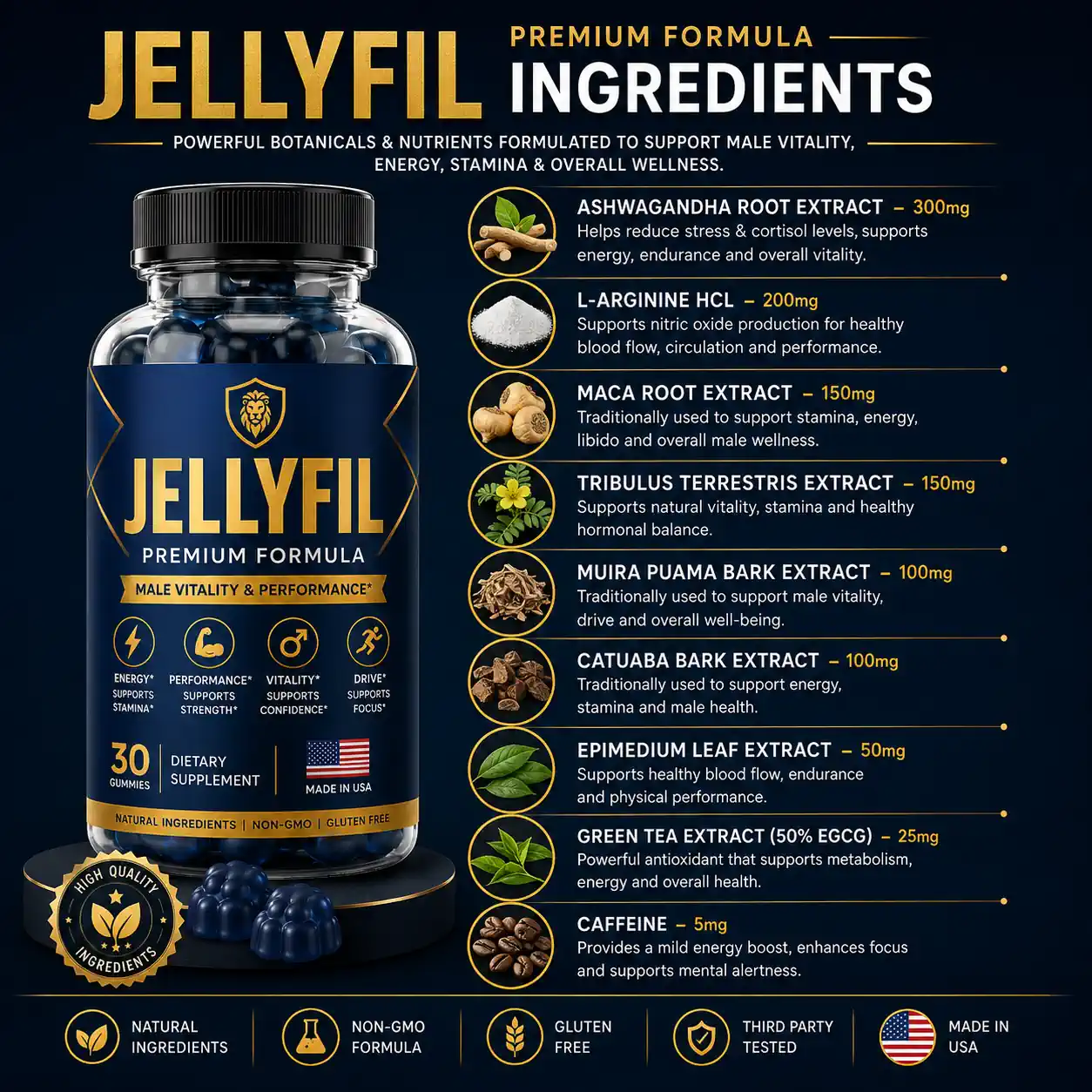
The label of a supplement tells you very little on its own. A list of nine botanical names doesn't mean much unless you know what each one does, where it comes from, and why it's inside the formula in the first place. This walkthrough covers every one of JellyFil's nine ingredients in plain English — without inflating anything, and without pretending traditional-use history is the same as clinical proof.
About the Blend
JellyFil's active formula is an 82mg proprietary blend, meaning the total weight of active ingredients per gummy is 82 milligrams. Only Caffeine (5mg) has an individually disclosed dose — the other eight ingredients share the remaining 77mg in proportions the manufacturer keeps to themselves. This is standard in botanical supplements, particularly ones based on traditional herbal formulations rather than isolated compounds. Below is what each of those nine ingredients actually is.
Muira Puama Extract (Ptychopetalum olacoides)
Muira Puama is a small Amazonian tree whose bark and root have a long history of traditional use in indigenous South American medicine — specifically as a tonic associated with men's daily wellness and general vitality. It's sometimes called "potency wood" in older texts, though the formal research base is thin and mostly focused on traditional-use documentation rather than modern clinical trials.
Maca Extract (Lepidium meyenii)
Maca is a root vegetable native to the high Andes of Peru, where it's been cultivated for over two thousand years as both food and traditional medicine. It's one of the most popular botanicals in modern men's wellness products — associated in traditional use with supporting daily energy, stamina, and general male vitality. Modern research on maca is more developed than most botanicals on this list, though still limited to smaller studies.
Catuaba Extract (Erythroxylum catuaba)
Catuaba is a small tree native to the Brazilian rainforest. Its bark has a long history of use in traditional Amazonian medicine, particularly in men's wellness contexts. Like Muira Puama, it comes from an ethnobotanical tradition that predates modern clinical research infrastructure — its inclusion in JellyFil is based on that traditional-use history, not on published Western clinical trials.
Green Tea Extract (Camellia sinensis)
Green tea extract is one of the most-studied botanical antioxidants in modern nutrition. It's rich in polyphenols — particularly catechins like EGCG — which have been associated in research with general antioxidant support and gentle daily energy. In JellyFil, green tea contributes both the antioxidant profile and a naturally occurring caffeine baseline.
Caffeine (5mg)
This is the only ingredient with an individually disclosed dose in JellyFil — and it's a modest one. Five milligrams is roughly 5% of a standard cup of coffee. It's enough for a gentle daily energy touch, not enough to produce the jitters, crash, or dependence that come with higher-stimulant supplements. If you're highly caffeine-sensitive, it's still worth noting; if you drink coffee at all, it's a rounding error.
Ashwagandha (Withania somnifera)
Ashwagandha is one of the most important herbs in Ayurvedic medicine, classified there as a rasayana (a rejuvenating tonic). It's an adaptogen — a category of herbs traditionally thought to support the body's response to everyday stress. Modern research on ashwagandha is more developed than most other botanicals on this list, particularly around stress-response and mood support.
L-Arginine
L-Arginine is an amino acid the body uses to produce nitric oxide, a signaling molecule involved in supporting healthy circulation and blood-flow function. It's the only non-botanical active ingredient in JellyFil, and the mechanism it works through is well-understood at the biochemical level. If you take blood pressure medication, nitrates, or blood thinners, this is the ingredient most worth flagging to your doctor.
Tribulus Terrestris
Tribulus is a spiky plant that grows across Mediterranean and Asian climates. It has a long history in Ayurvedic medicine (where it's called gokshura) and traditional Chinese medicine, primarily in the context of men's wellness tonics. Modern clinical research on tribulus is mixed and often small-scale, but its traditional-use pedigree is extensive.
Horny Goat Weed Extract (Epimedium sagittatum)
Despite the unusual name, this is a serious medicinal herb in traditional Chinese medicine, where it's known as yin yang huo. It's been used for centuries in men's wellness formulations. The active compound most associated with it is icariin, a flavonoid that has drawn some modern research interest.
The pattern across all nine ingredients: strong traditional-use history, more limited modern clinical data, and a formulation strategy of combining several botanicals traditionally used for the same category of support rather than betting on any one ingredient alone.
That's the honest picture. JellyFil's nine-ingredient stack draws on traditional men's wellness formulations from several herbal traditions (Amazonian, Ayurvedic, Chinese, Mediterranean), combined with two more modern additions (L-Arginine and Green Tea Extract). The blend approach is a legitimate strategy — most traditional formulations work through multi-ingredient combinations rather than isolated compounds. The trade-off is that individual dosages aren't disclosed, so direct comparison against research doses isn't possible.